How to Choose the Right Generator Size for Your Home
One strong storm, one blown transformer, and suddenly your house is dark, sticky, and too quiet. The fridge hum is gone. The ceiling fan stops. The sump pump? Hopefully it holds out.
That’s why more homeowners are investing in generators, but not everyone knows the exact size they need. Some get one too small and can’t run the AC. Others overspend on a system that powers rooms they never use.
Let’s walk through how to match the right generator to your real, everyday needs.
What Do You Actually Need to Power?
Before we get into numbers, think about what you can’t go without when the power’s out. What do you reach for first? What would cause the most trouble if it stopped working?
Some people need the basics, like the fridge to keep food cold and a few lights to move around safely. Others need more, like air conditioning during a hot summer, a well pump for water, or medical equipment that has to stay on.
Everyone’s list looks different depending on their home and daily routine. Maybe you need the microwave for meals, a sump pump to keep your basement dry, or Wi-Fi to work from home.
Here are a few things many homeowners want their generator to power:
- Fridge and freezer
- AC or heaters
- Sump pump or dehumidifier
- Lights in a few rooms
- Phone chargers, router, and laptop
- Medical devices like a CPAP or oxygen machine
Let’s Talk Watts
Every appliance or system on that list pulls a certain number of watts. And some pull more when they’re first turned on; this is called starting wattage. That quick surge of power is what trips undersized generators most often.
To keep it simple:
- A fridge might use 700 running watts, but needs 1,400 to start
- A small window AC might run on 1,000 watts, but start at 1,800
- A central AC could need 4,000 to 6,000 watts or more, depending on the size
Add up the starting wattage for everything that might kick on at once, then add a little buffer (10–20%) just to be safe. That’s your minimum generator size.
Portable vs. Whole-Home Generators
Generators come in two main types. Some are small and portable, while others are whole-home systems that turn on automatically when the power goes out.
Portable generators are ideal for running a few essentials, such as your fridge, some lights, and possibly a fan. They usually give you between 3,000 and 8,000 watts of power. They cost less, but you have to set them up manually, and they can’t power everything in your home.
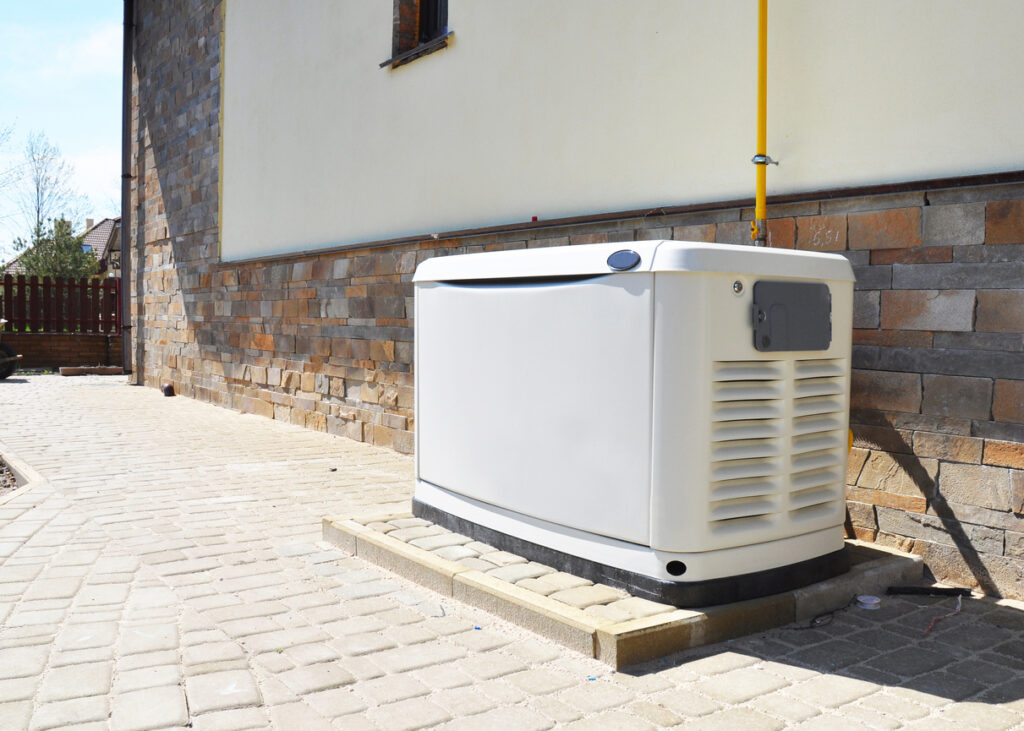
Whole-home generators are installed directly into your home’s electrical system. They turn on by themselves during an outage and can power your entire house, including your AC and major appliances. These systems usually provide 20,000 watts or more.
So, which one should you choose? If you need the basics for a short time, a portable generator might work. But if you want to stay fully comfortable during long outages, a whole-home generator is the better option.
Why Sizing Your Generator Wrong Can Cost You
We’ve seen it too many times; someone buys a generator based on guesswork or what a big-box store had on sale. It works great until they plug in one too many things and blow a breaker.
A generator that’s too small can:
- Overload and shut down
- Damage appliances
- Fail when you need it most
A generator that’s too large can:
- Cost more to install and run
- Use more fuel than needed
- Take up more space than necessary
That’s why it’s worth getting the sizing right the first time.
Need Help? Let Stuart Services Do It Right
At Stuart Services, we’ve been helping NOLA homeowners stay powered and protected since 1956. Whether you’re looking for a backup solution for a few appliances or full whole-home coverage, our licensed electricians are here to guide you. We offer free quotes on generator installations and back our work with The Stuart Standard.
Contact Stuart Services today for a free generator installation quote in New Orleans. Let Stuart Do It.
h3 heading
h4 heading
 Request Service today
Sidebar

Home Safety Plans
Protect your family and your home for as little as $9.99/ month
 Cooling & Heating plan
Only
Cooling & Heating plan
Only $17.99/Month Cooling & Heating Plan
 Plumbing plan
ONLY
Plumbing plan
ONLY $9.99/MONTH Plumbing plan
 Tankless Water Heater Plan
ONLY
Tankless Water Heater Plan
ONLY $17.99/MONTH Tankless Water Heater Plan
 generator plan
ONLY
generator plan
ONLY $31.99/MONTH generator plan
 electrical plan
ONLY
electrical plan
ONLY $9.99/MONTH electrical plan